AI work

AI systems I run and what they measured

Each build below runs on real work, has a check that can fail, and says what it does not do.

Featured

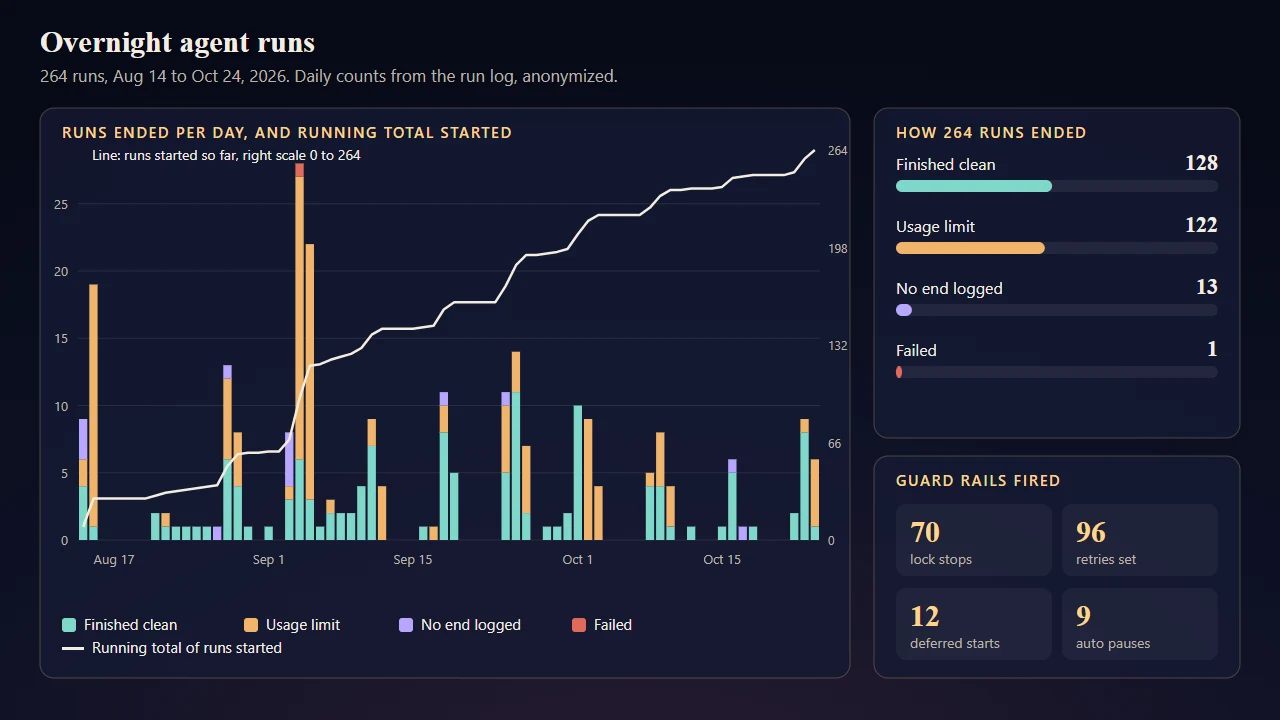
Chart of 264 overnight agent runs from August 14 to October 24, 2026. Bars show runs ended per day: 128 finished clean, 122 hit a usage limit, 13 had no end logged and 1 failed. A line shows the running total of runs started. Tiles show 70 lock stops, 96 retries set, 12 deferred starts and 9 automatic pauses.
RunningAI agents and governance

Overnight agent runner

I run Claude Code agents on my own machine at night, on a schedule, with nobody watching. A task list goes in. The agent works through it, saves its results, and stops when it finishes or hits a usage limit. From August 14 to October 24 the log shows 264 runs. 128 finished cleanly and 122 ended on a usage limit.

The safeguards matter more than the agent. Each one exists because something went wrong first.

  • One run at a time. A lock blocked 70 starts that would have put two agents on one task list.
  • Quiet hours. A run that fires outside the allowed window waits. 12 starts were deferred.
  • Kill switch. One switch pauses every run, and repeated usage limits trip it automatically.
  • Bounded retries. After a usage limit a run retries a set number of times, then stops. 96 retries were scheduled.
  • Time limit. A run that outlives its ceiling is taken over, and its stray processes are cleaned up.
  • Nothing goes out without me. Runs draft and prepare. I send and publish.

In August 2026 three scheduled jobs kept re-queuing after every reset and used up my whole usage limit for four days. I found the cause, and the safeguards came from that. The runner itself is not published.
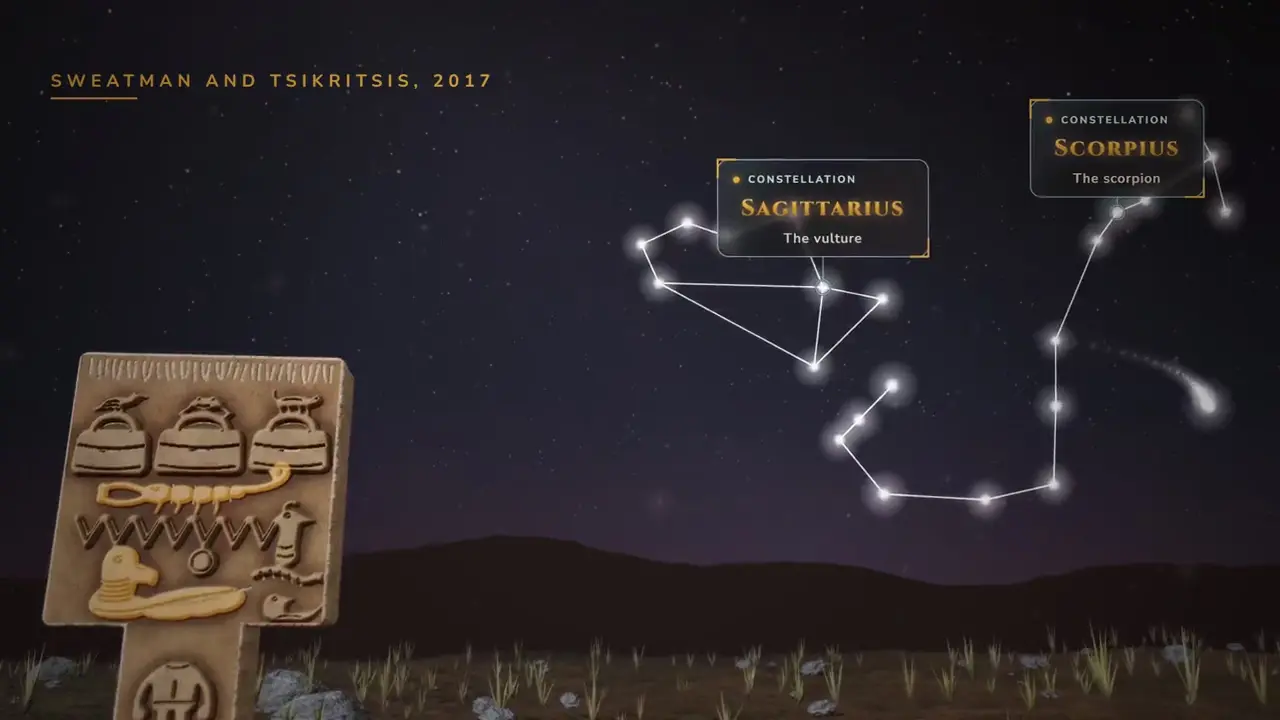
A carved stone pillar from a 3D scene made by the video engine
RunningAI media and channel operations

Script-to-video engine and two YouTube channels

I run two faceless YouTube channels, one on history and one on parenting education. No one films or records anything. I write a script file. The engine turns it into a narrated 1080p video. Channel links are available on request through the contact form.

How the engine works

  • 3D scenes. A headless browser draws every frame with Three.js. Scenes include real satellite terrain maps, a 3D flood, carved stone and animated models.
  • Local voice. A local text-to-speech model (Kokoro) reads the script. A pronunciation dictionary and a guard stop the voice from spelling out hard names.
  • Words drive pictures. The engine records the time of every spoken word. A label appears on its word. Captions come from the same timing.
  • Cache. A fix in one chapter re-renders that chapter, not the whole video.
  • Render watchdog. A frozen render is detected and restarted, up to three times. A render queue waits for free memory.
  • Checks before a render. The build stops if a claim has no source, an image has no credit, or the voice would mispronounce a word. A set of automatic rules also flags repeated pictures, dead air and overlapping labels.
  • Tests. More than 600 automated tests cover the checks, the cache, the voice guard and the upload steps.
  • Review agents. A separate read-only agent attacks each script and each set of rendered frames before a render. A second pass runs before upload. It reports faults and never edits.

How I run the channels

  • Planning. A series plan per channel. Each video is built for search and stays useful later.
  • Scripts with sources. Every claim in a history script cites a source. Both sides of a disputed idea are shown, and fringe claims are never stated as fact.
  • Shorts. The history channel runs 2 Shorts a day. The parenting channel runs 1 a day.
  • Publishing. The YouTube API uploads each file with its schedule, captions, thumbnail and a description that links every resource used.
  • Title and thumbnail tests. Variants A, B and C are built and logged for each video, with the lesson written down. Live testing is paused until YouTube verification clears. Each video ships with one title and one thumbnail.
  • Stats review. I pull views and watch data on a schedule and write down what the numbers say.
11long videos public
64Shorts public
4more long videos scheduled
600+automated tests

Counts are across both channels as of October 2026, read from the YouTube API on October 28. The channels are young and small. I do not claim audience results.

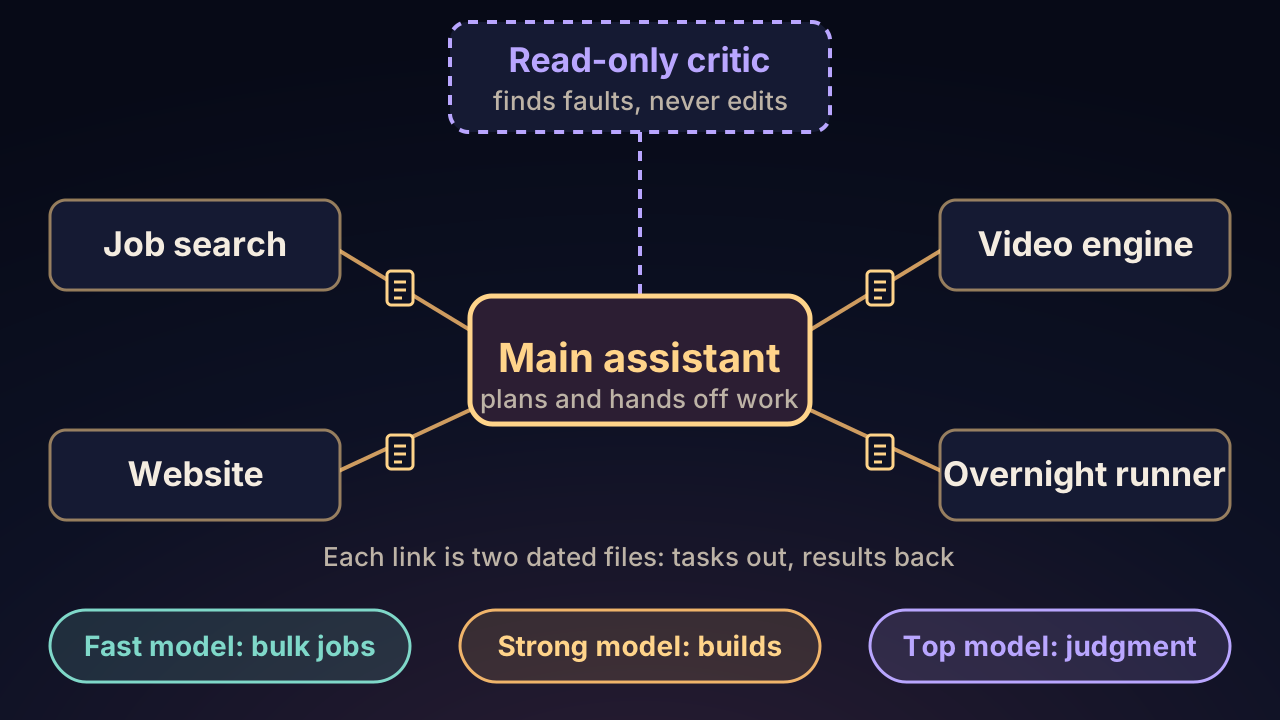
Diagram. A main assistant sits in the centre. Four lane agents link to it through task and result files: job search, video engine, website and overnight runner. A read-only critic checks the work. Three model tiers: a fast model for bulk jobs, a strong model for builds, a top model for judgment.
RunningAI agents and governance

A multi-agent operating model

One main assistant plans the work and hands it to lane agents, each with one job. A lane could be the job search, the video engine or the site. Agents never relay messages through me. Each lane has two plain files. The main assistant writes tasks to one and reads results from the other. Each entry is dated and marked open or done.

  • Cost tiers. A cheap fast model does high-volume jobs such as stats pulls and formatting. A stronger model builds. The strongest model is kept for judgment.
  • A critic that cannot edit. The review agent is read-only. It finds faults. Someone else fixes them.
  • Corrections become rules. When I correct an agent, the correction is added to a shared rules file that every agent reads first.
  • A line agents cannot cross. Agents draft and prepare. A person sends, publishes and spends.

More AI builds

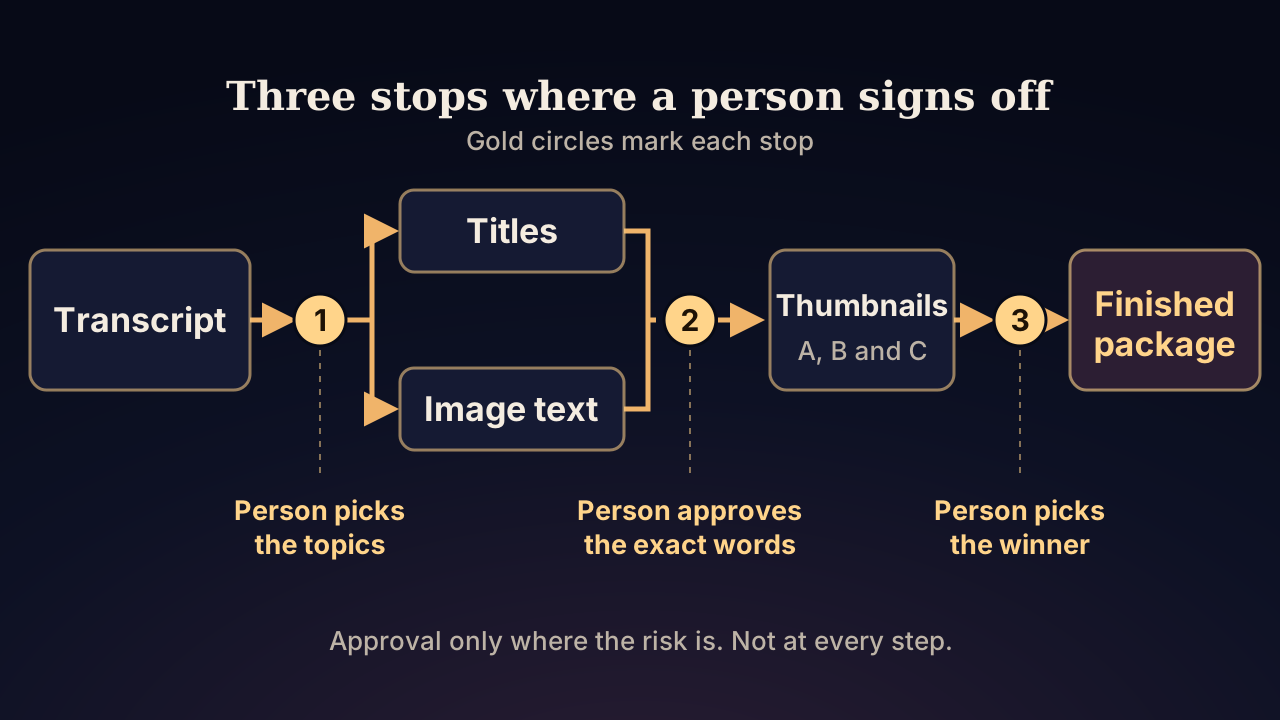
Flow diagram. A transcript becomes titles and image text, then thumbnails A, B and C, then a finished package. A person signs off at three stops: picking the topics, approving the exact words and picking the winning thumbnail.
ShippedAI workflows

AI packaging workflow for a podcast network

A transcript goes in. Titles, image text and finished thumbnails come out, with three stops where a person signs off. It ran across three shows from June to August 2026. The engagement has ended.